Thaumatotibia leucotreta
TaxID: 463830
Basic Information
Thaumatotibia leucotreta
False Codling Moth
Thaumatotibia (Cryptophlebia) leucotreta, commonly known as the false codling moth, orange moth, citrus codling moth or orange codling moth, is a moth in the family Tortricidae under the order of Lepidoptera. Larvae of the moth feed on a wide range of crops from cotton and macadamia nuts to Citrus species. The larvae have a less selective diet than the codling moth, which feeds primarily on temperate fruit crops. The moth is believed to have originated in Sub-Saharan Africa. Outside of Africa the false codling moth has had limited success in establishing itself; however, this insect has been detected in Europe and the United States. From 1984 to 2008, there have been 1500 interceptions of the moth on 99 plant taxa at 34 ports of entry in the United States. The false codling moth is adapted for warm climate survival. Temperatures below 10 degrees Celsius impede development and reduce survival rates. Below 1 degree Celsius, all stages of the life cycle are terminated resulting in death. The species is prone to alternate-year infestation severity. Under ideal conditions (warm and humid) up to five generations a year may be produced.
from Wikipedia
Taxonomic Information
Metazoa
Arthropoda
Insecta
Lepidoptera
Tortricidae
Thaumatotibia
leucotreta
unclassified
Species
nan
k__Metazoa;p__Arthropoda;c__Insecta;o__Lepidoptera;f__Tortricidae;g__Thaumatotibia;s__Thaumatotibia leucotreta
nan
Arthropods
Photos (5 photos)
Morphological Features
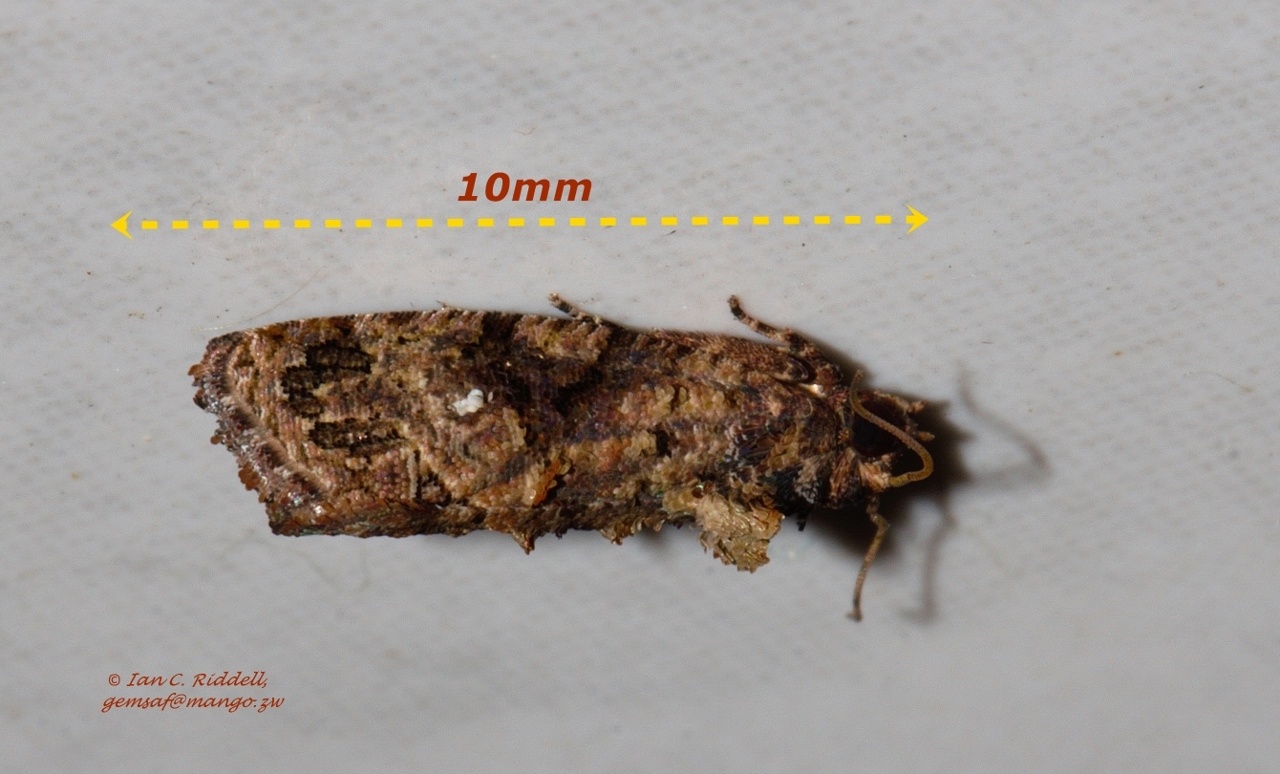
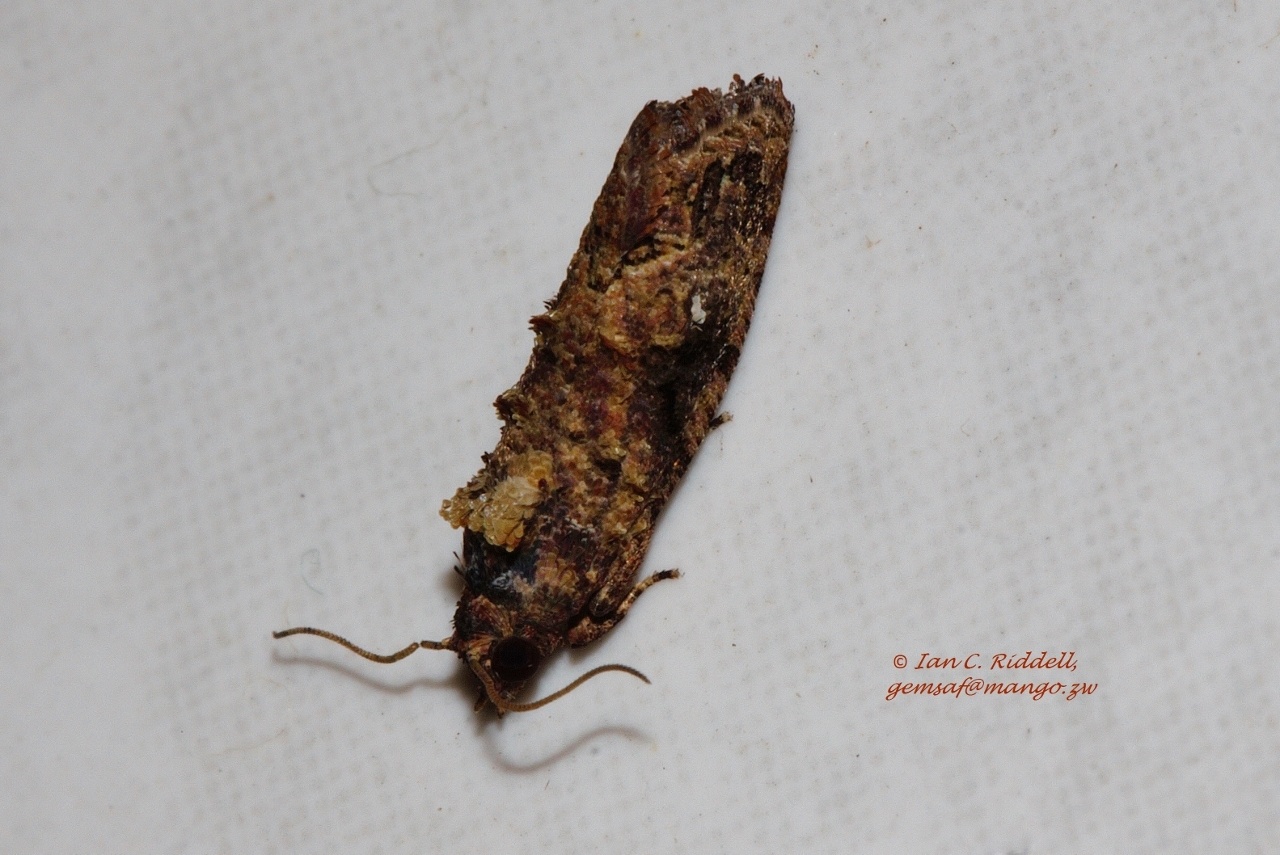
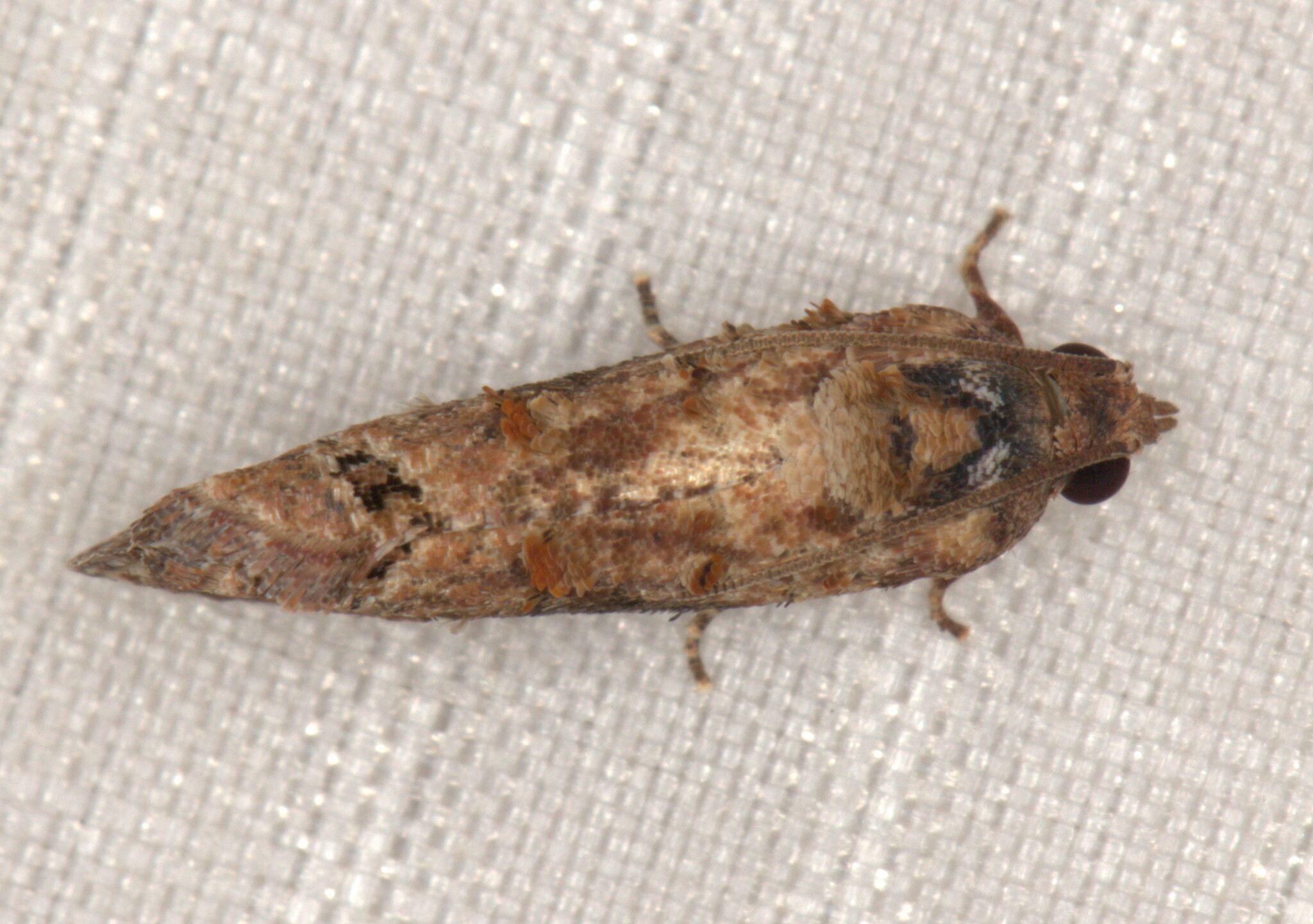
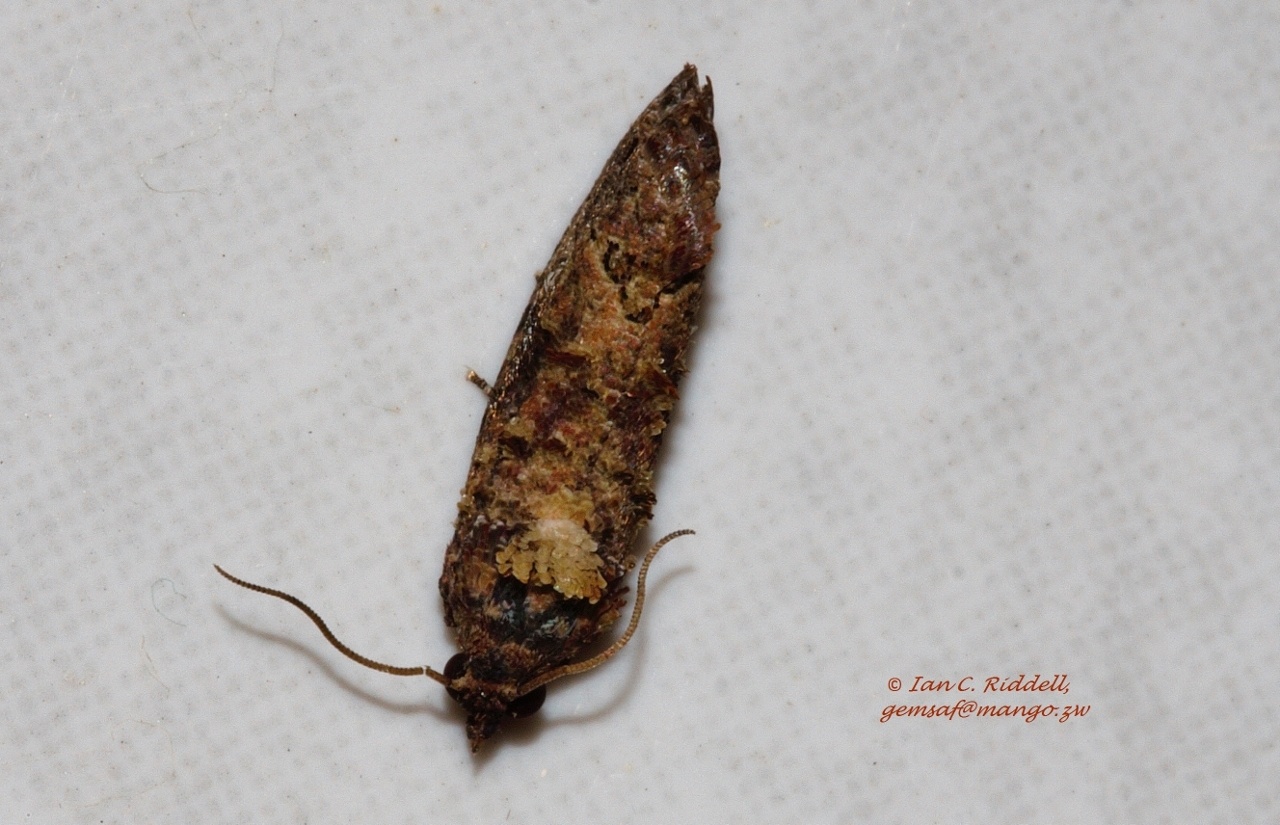
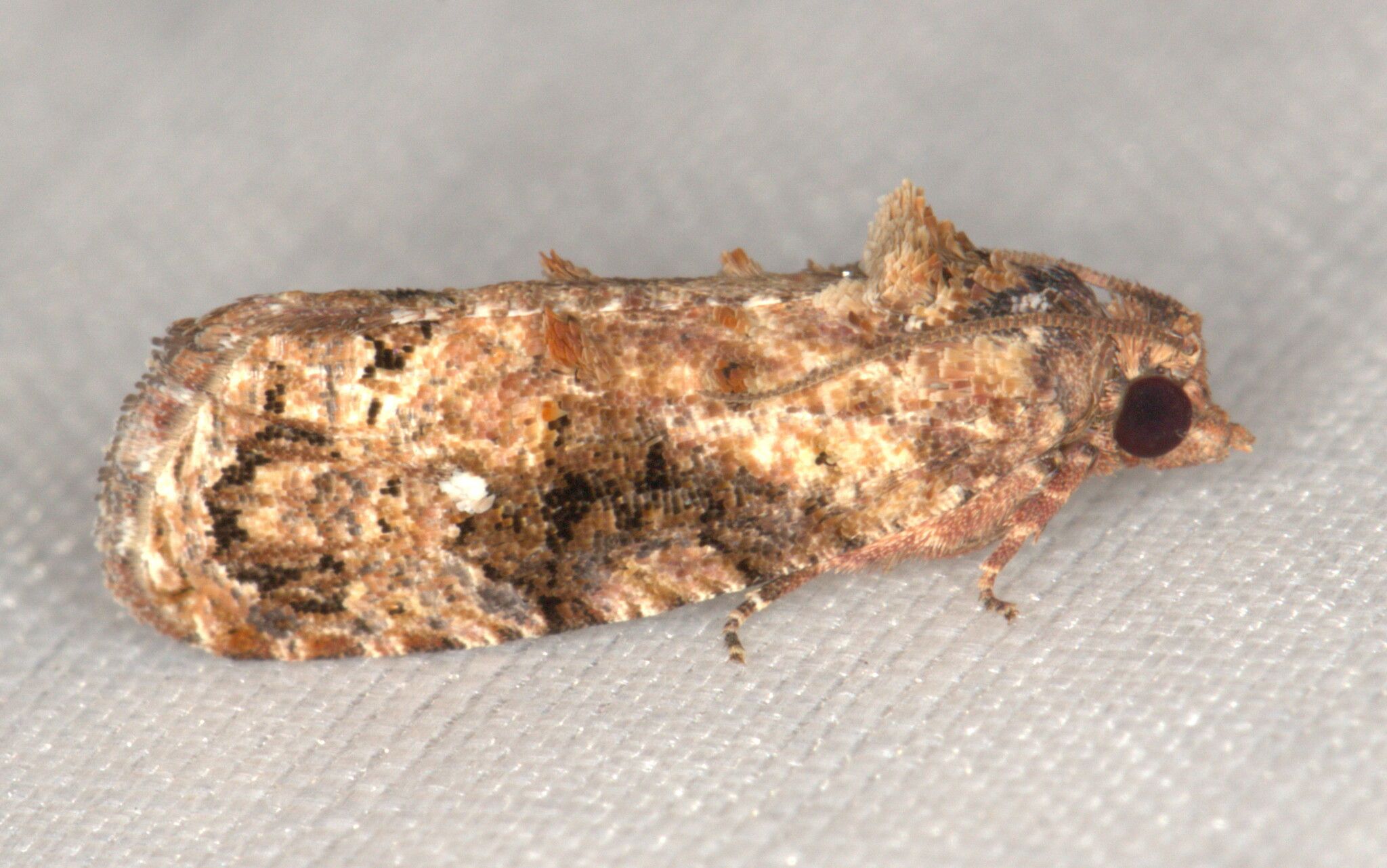
Adults are sexually dimorphic, mottled brown, with two dorsal tufts on the thorax . The forewing features a small white dot at the distal end of the discal cell, a patch of raised rust-colored scales in the middle, a dark-colored 'question mark' along the termen, and a broad semi-circular band of dark scales in the middle of the costa . Males have a prominent semi-circular patch of opalescent scales on the lower margin of the hindwing and heavily tufted metatibia . Eggs are small (0.77 mm long, 0.60 mm wide), slightly convex, oval, translucent, and covered with a granulated shell; color changes from creamy white to orange with progressive larval development . Young larvae are cream-colored with a brown head capsule and greyish-brown pinacula; late larval stages are orange-pink with a caramel-colored head capsule and prothoracic plate . Key diagnostic larval features include the enlarged, cigar-shaped L-pinaculum on T1 extending beneath and beyond the spiracle, and the presence of an anal comb
EPPO (2024). Thaumatotibia leucotreta datasheet. EPPO Global Database.
Host Plants (93 host plants)
Data sources: EPPO Global Database and relevant literature.
| Scientific Name | Status |
|---|---|
| Abelmoschus esculentus | Host |
| Abutilon x hybridum | Host |
| Afrocarpus falcatus | Host |
| Afrocarpus gracilior | Host |
| Agelaea pentagyna | Host |
| Albuca sp. | Host |
| Allophylus ferrugineus | Host |
| Ananas comosus | Host |
| Annona muricata | Host |
| Aristolochia albida | Host |
Quarantine Status (64 records)
Data sources: IPPC website and national quarantine websites; verified by human review.
| Country | Status | Year Added |
|---|---|---|
| Argentina | Absent | 2019 |
| Austria | Quarantine pests | 2019 |
| Belgium | Unknow | 2019 |
| Bulgaria | Quarantine pest ((EU) 2019/2072 Annex II A) | 2019 |
| Brazil | A1 list | 2018 |
| Canada | Quarantine pests | 2019 |
| Switzerland | A1 list | 2019 |
| Chile | A1 list | 2019 |
| China | Quarantine pests | 2021 |
| Cyprus | Quarantine pest ((EU) 2019/2072 Annex II A) | 2019 |
Distribution (57 countries)
Data Sources: EPPO Global Database and GBIF.
| Country | Status | State |
|---|---|---|
| Angola | Present | — |
| Burundi | Present | — |
| Belgium | Absent | — |
| Benin | Present | — |
| Burkina Faso | Present | — |
| Botswana | Absent | — |
| Central African Republic | Present | — |
| Switzerland | Absent | — |
| Côte d'Ivoire | Present | — |
| Cameroon | Present | — |
Distribution Map (Latitude and longitude coordinates sourced from GBIF.)
Download CSVGenomes (0 records)
Data source: NCBI.
No genome records available.
Transcriptomes (3 records)
Data source: NCBI.
| Run ID | Tissue | Developmental Stage | Sex | Read Count | Location | Actions |
|---|---|---|---|---|---|---|
| SRR26949489 | Whole insect | - | - | 18921662 | Kenya: Makueni | |
|
PRJNA1044547 SRX22643264 SRP474245 insect Transcriptome of Thaumatotibia leucotreta TruSeq Stranded mRNA LT Sample Prep Kit was used to construct each library from 1 g total RNA from the whole body of three individuals (pooled) of T. leucotreta larvae per treatment. The sequenced using the HiSeq 4000 System with a 101 bp paired-end read {'host': 'Citrus sinensis', 'tissue': 'Whole insect', 'lat_lon': '1.786494 S 37.964442 E', 'collected_by': 'Nelson Mwando', 'geo_loc_name': 'Kenya: Makueni', 'biosamplemodel': 'Invertebrate', 'collection_date': '2015-06-15', 'biomaterial_provider': 'ICIPE00N8'} |
||||||
| SRR26949488 | Whole insect | - | - | 18698601 | Kenya: Makueni | |
|
PRJNA1044547 SRX22643265 SRP474245 insect Transcriptome of Thaumatotibia leucotreta TruSeq Stranded mRNA LT Sample Prep Kit was used to construct each library from 1 g total RNA from the whole body of three individuals (pooled) of T. leucotreta larvae per treatment. The sequenced using the HiSeq 4000 System with a 101 bp paired-end read {'host': 'Citrus sinensis', 'tissue': 'Whole insect', 'lat_lon': '1.786494 S 37.964442 E', 'collected_by': 'Nelson Mwando', 'geo_loc_name': 'Kenya: Makueni', 'biosamplemodel': 'Invertebrate', 'collection_date': '2015-06-15', 'biomaterial_provider': 'ICIPE00N9'} |
||||||
| SRR26949487 | Whole insect | - | - | 19517479 | Kenya: Makueni | |
|
PRJNA1044547 SRX22643266 SRP474245 insect Transcriptome of Thaumatotibia leucotreta TruSeq Stranded mRNA LT Sample Prep Kit was used to construct each library from 1 g total RNA from the whole body of three individuals (pooled) of T. leucotreta larvae per treatment. The sequenced using the HiSeq 4000 System with a 101 bp paired-end read {'host': 'Citrus sinensis', 'tissue': 'Whole insect', 'lat_lon': '1.786494 S 37.964442 E', 'collected_by': 'Nelson Mwando', 'geo_loc_name': 'Kenya: Makueni', 'biosamplemodel': 'Invertebrate', 'collection_date': '2015-06-15', 'biomaterial_provider': 'ICIPE00N10'} |
||||||
Literature
Fetching literature from NCBI PubMed...
Failed to fetch literature