Bactrocera tryoni
TaxID: 59916
Basic Information
Bactrocera tryoni
Queensland fruit fly, Fruchtfliege Queensland, Queensland Fruit Fly
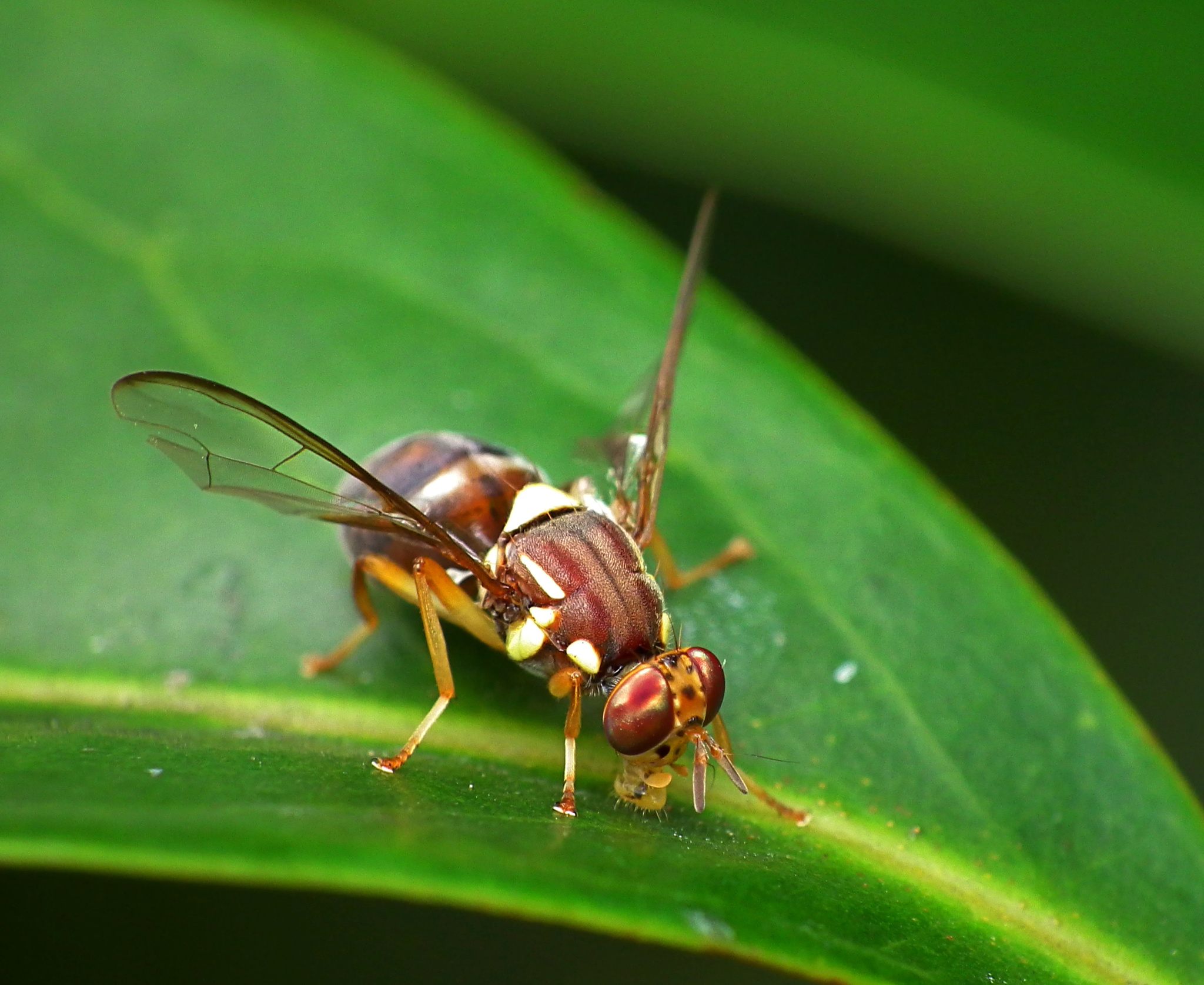
Bactrocera tryoni, the Queensland fruit fly, is a species of fly in the family Tephritidae in the insect order Diptera. B. tryoni is native to subtropical coastal Queensland and northern New South Wales. They are active during the day, but mate at night. B. tryoni lay their eggs in fruit. The larvae then hatch and proceed to consume the fruit, causing the fruit to decay and drop prematurely. B. tryoni are responsible for an estimated $28.5 million a year in damage to Australian crops and are the most costly horticultural pest in Australia. Up to 100% of exposed fruit can be destroyed due to an infestation of this fly species. Previously, pesticides were used to eliminate B. tryoni from damaging crops. However, these chemicals are now banned. Thus, experts devoted to B. tryoni control have transitioned to studying this pests' behaviors to determine a new method of elimination.
from Wikipedia
Taxonomic Information
Metazoa
Arthropoda
Insecta
Diptera
Tephritidae
Bactrocera
tryoni
unclassified
Species
nan
k__Metazoa;p__Arthropoda;c__Insecta;o__Diptera;f__Tephritidae;g__Bactrocera;s__Bactrocera tryoni
nan
Arthropods
Photos (5 photos)
Morphological Features
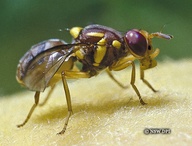
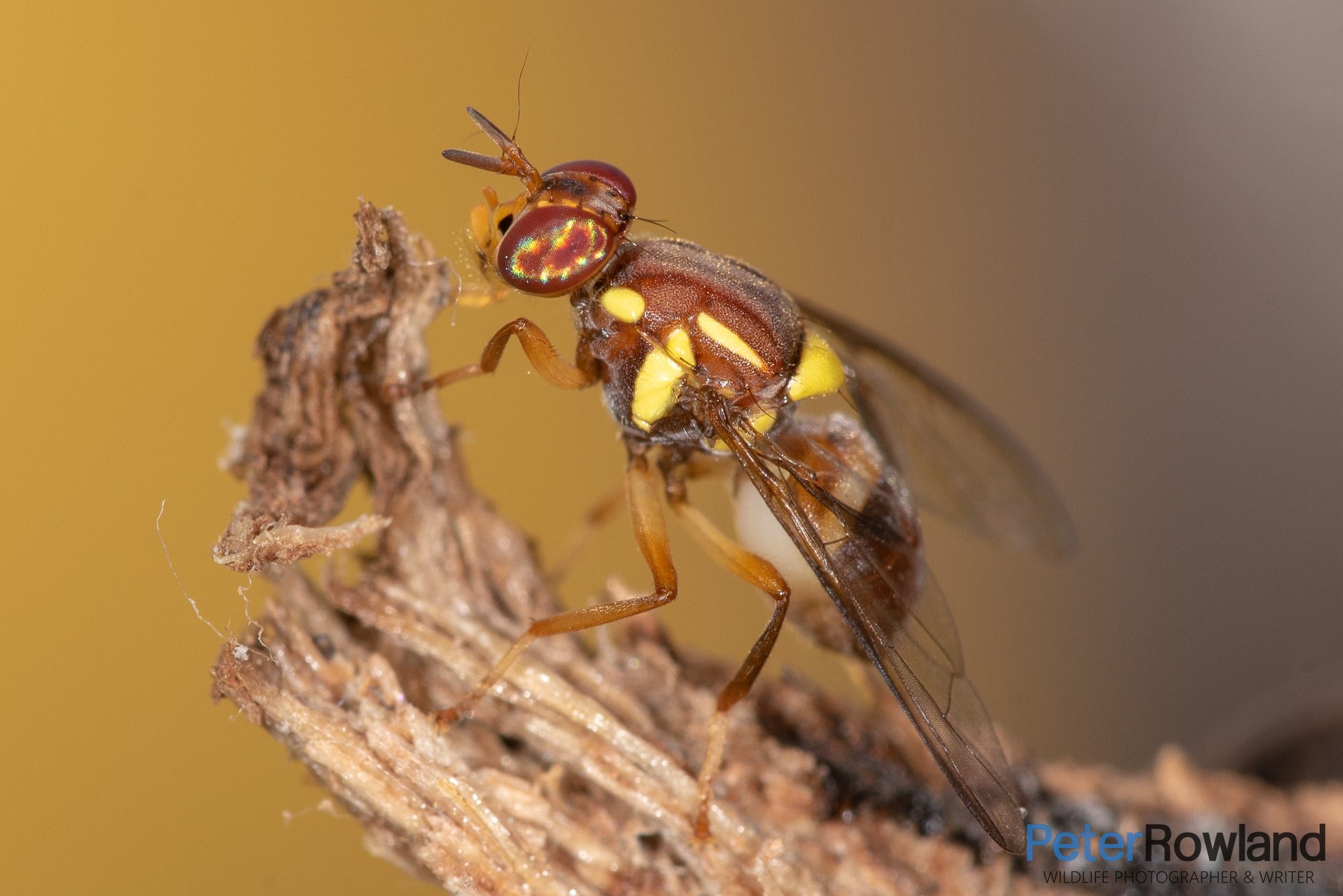
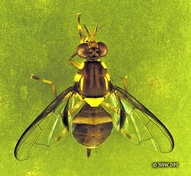
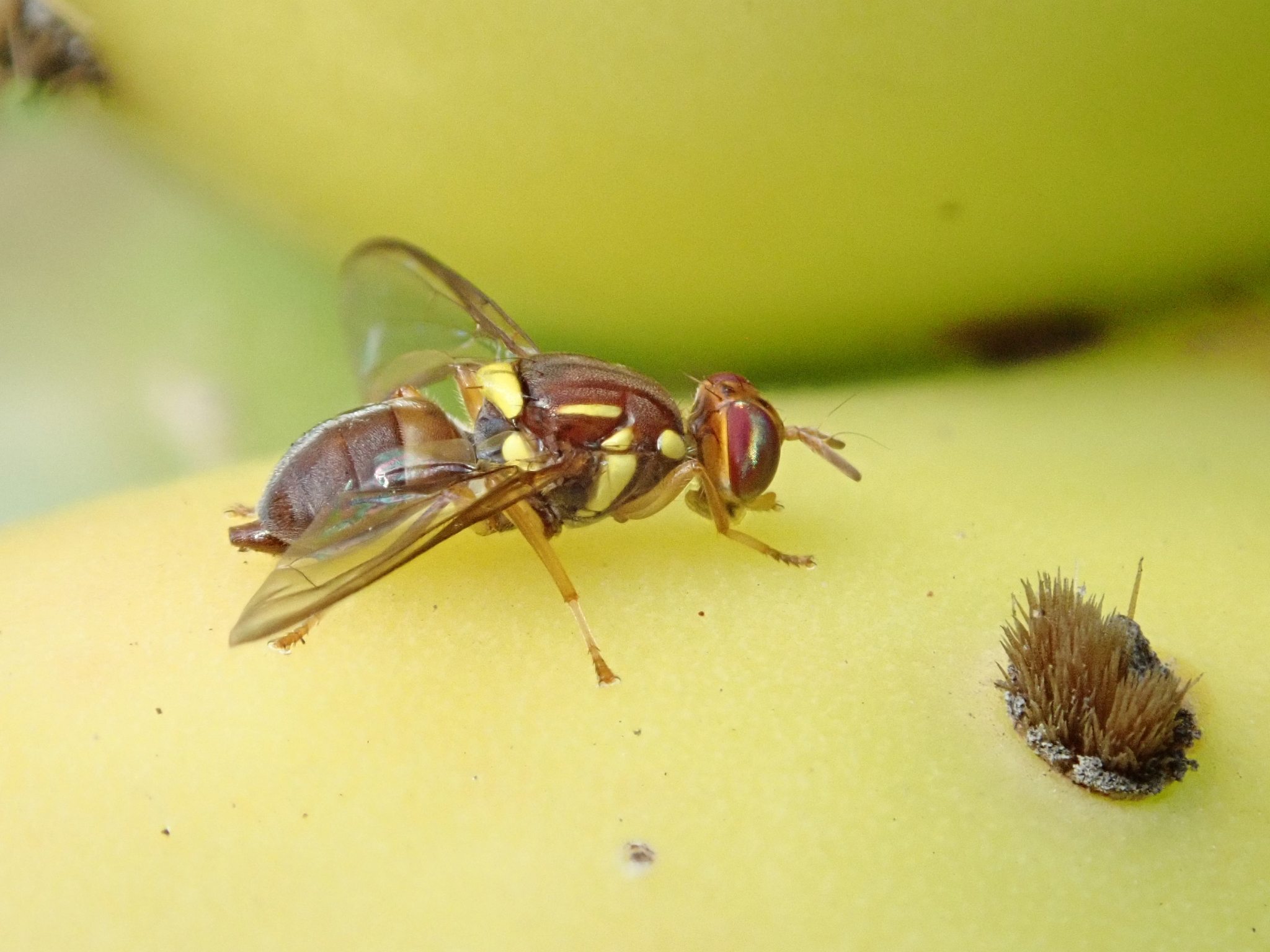
Medium sized species (5–8 mm). Head with medium sized black facial spots. Thorax: postpronotal lobes (humeral calli) and notopleura yellow; scutum red-brown with fuscous markings; mesopleural stripe reaching midway between anterior margin of notopleuron and anterior notopleural seta; lateral postsutural vittae present, medial postsutural vitta absent; scutellum yellow. Wing with narrow fuscous costal band and broad fuscous anal streak; cells bc and c fuscous; microtrichia covering cell c and outer half of cell bc. Abdomen: terga III–V generally red-brown with a medial and two broad lateral longitudinal fuscous bands over all three terga, joined along anterior margin of tergum III; paler forms often present. Female with apex of aculeus needle-shaped.
Drew, R. A. I. (1989). The tropical fruit flies (Diptera: Tephritidae: Dacinae) of the Australasian and Oceanian regions. Memoirs of the Queensland Museum, 26, 1–521. (as cited in EPPO datasheet and Fruit Fly ID Australia)
Host Plants (224 host plants)
Data sources: EPPO Global Database and relevant literature.
| Scientific Name | Status |
|---|---|
| Acronychia acidula | Host |
| Acronychia laevis | Host |
| Acronychia vestita | Host |
| Actinidia deliciosa | Host |
| Aegle marmelos | Host |
| Aglaia sapindina | Host |
| Alyxia ruscifolia | Host |
| Amorphospermum antilogum | Host |
| Anacardium occidentale | Host |
| Annona glabra | Host |
Quarantine Status (74 records)
Data sources: IPPC website and national quarantine websites; verified by human review.
| Country | Status | Year Added |
|---|---|---|
| Albania | Absent | — |
| Argentina | A1 list | 2019 |
| Austria | Absent | 2019 |
| Belgium | Quarantine pest ((EU) 2019/2072 Annex II A) | 2019 |
| Bulgaria | Quarantine pest ((EU) 2019/2072 Annex II A) | 2019 |
| Bahrain | Quarantine pests | 2003 |
| Brazil | A1 list | 2018 |
| Cambodia | Quarantine pests | — |
| Switzerland | A1 list | 2019 |
| Chile | A1 list | 2024 |
Distribution (16 countries)
Data Sources: EPPO Global Database and GBIF.
| Country | Status | State |
|---|---|---|
| Australia | Absent | |
| Australia | Present | |
| Chile | Absent | — |
| Cook Islands | Absent | — |
| India | Present | — |
| Northern Mariana Islands | Absent | — |
| New Caledonia | Present | — |
| Netherlands | Absent | — |
| New Zealand | Transient | — |
| Pitcairn | Present | — |
Distribution Map (Latitude and longitude coordinates sourced from GBIF.)
Download CSVGenomes (3 records)
Data source: NCBI.
| Assembly Accession | Assembly Level | Genome Size(Mb) | Contig N50(Kb) | Scaffold N50(Kb) | BUSCO% | Downloads | Actions |
|---|---|---|---|---|---|---|---|
| GCF_016617805.1 | Chromosome | - | - | - | - | - |
|
|
CSIRO_BtryS06_freeze2 |
|||||||
| GCA_016617805.2 | Chromosome | 570 | 350 | 81886 | - |
|
|
|
|
|||||||
| GCA_000695345.1 | Scaffold | - | - | - | - | - |
|
|
Assembly 2.2 of Bactrocera tryoni genome |
|||||||
Transcriptomes (3 records)
Data source: NCBI.
| Run ID | Tissue | Developmental Stage | Sex | Read Count | Location | Actions |
|---|---|---|---|---|---|---|
| SRR29744212 | head | adult | female | 35316529 | Australia:Brisbane | |
|
PRJNA936454 SRX25245288 SRP518594 insect RNAseq of Bactrocera tryoni: adult female heads Libraries prepared using the Illumina Stranded mRNA library prep kit. Each library number (first number) refers to the same biosample, which were prepared in technical triplicates during library prep (e.g., 1A, 1B, 1C are all the same biosample, RNA from which was prepared into three libraries - technical triplicates A, B and C.) pooled individuals (head tissue) {'age': '14-22 days old', 'sex': 'female', 'tissue': 'head', 'isolate': 'pooled individuals (head tissue)', 'dev_stage': 'adult', 'collected_by': 'Chloe van der Burg', 'geo_loc_name': 'Australia:Brisbane', 'biosamplemodel': 'Invertebrate', 'collection_date': '2021-12-28', 'isolation_source': 'Wild infested fruit collected and larvae reared to adulthood in an insectary'} |
||||||
| SRR29744211 | head | adult | female | 28893815 | Australia:Brisbane | |
|
PRJNA936454 SRX25245289 SRP518594 insect RNAseq of Bactrocera tryoni: adult female heads Libraries prepared using the Illumina Stranded mRNA library prep kit. Each library number (first number) refers to the same biosample, which were prepared in technical triplicates during library prep (e.g., 1A, 1B, 1C are all the same biosample, RNA from which was prepared into three libraries - technical triplicates A, B and C.) pooled individuals (head tissue) {'age': '14-22 days old', 'sex': 'female', 'tissue': 'head', 'isolate': 'pooled individuals (head tissue)', 'dev_stage': 'adult', 'collected_by': 'Chloe van der Burg', 'geo_loc_name': 'Australia:Brisbane', 'biosamplemodel': 'Invertebrate', 'collection_date': '2022-01-18', 'isolation_source': 'Wild infested fruit collected and larvae reared to adulthood in an insectary'} |
||||||
| SRR29744210 | head | adult | female | 31455255 | Australia:Brisbane | |
|
PRJNA936454 SRX25245290 SRP518594 insect RNAseq of Bactrocera tryoni: adult female heads Libraries prepared using the Illumina Stranded mRNA library prep kit. Each library number (first number) refers to the same biosample, which were prepared in technical triplicates during library prep (e.g., 1A, 1B, 1C are all the same biosample, RNA from which was prepared into three libraries - technical triplicates A, B and C.) pooled individuals (head tissue) {'age': '14-22 days old', 'sex': 'female', 'tissue': 'head', 'isolate': 'pooled individuals (head tissue)', 'dev_stage': 'adult', 'collected_by': 'Chloe van der Burg', 'geo_loc_name': 'Australia:Brisbane', 'biosamplemodel': 'Invertebrate', 'collection_date': '2022-01-18', 'isolation_source': 'Wild infested fruit collected and larvae reared to adulthood in an insectary'} |
||||||
Literature
Fetching literature from NCBI PubMed...
Failed to fetch literature