Globodera pallida
TaxID: 36090
Basic Information
Globodera pallida
Golden Nematode, Pale Potato Cyst Nematode
Globodera pallida is a species of nematode in the family Heteroderidae. It is well known as a plant pathogen, especially of potatoes. It is "one of the most economically important plant parasitic nematodes," causing major crop losses, and is a model organism used to study the biology of cyst nematodes. Its common names include potato cyst nematode, white potato cyst nematode, pale potato cyst nematode, potato root eelworm, golden nematode, and pale cyst nematode. The female has a globe-shaped body with a thick, lacy cuticle. It retains its eggs inside its body rather than releasing them, and becomes a brown cyst when it dies. The female is white to cream in color. Globodera rostochiensis is similar in appearance, but the female is yellow in color for part of its life. The male has a wormlike body which is held in a C- or S-shape. This nematode is thought to be native to the Andes. Today it is found in 55 countries, mostly in temperate regions. The microscopic cysts are tough and can survive in soil particles, which are transported around the world on objects such as farming equipment and in flowing water. It has been primarily distributed on potatoes, which were introduced from South America to the rest of the world. It can also live on other solanaceous crops such as tomato and eggplant, and many solanaceous weed species, such as black nightshade (Solanum nigrum). The juvenile nematodes feed on the roots of the plant. Eggs develop inside the females after fertilization, and when the females die they become tough cysts that protect the mature eggs. The eggs in the cysts can remain viable for up to 30 years. The cysts detach from the roots and drop into the soil, where they can be distributed via soil movement. An infested plant becomes yellow and wilted and loses its leaves. This nematode is an important agricultural pest, especially in Europe. It causes economic losses of about 50 million per year in the United Kingdom alone. Laws defining best management practices have been passed to reduce the spread of the pest. The movement of soil and potatoes across national boundaries is monitored with quarantines. Farming equipment is cleaned, soil is tested for nematodes, contaminated soil is kept out of fields, and resistant cultivars of crops are alternated with susceptible varieties to reduce the possibility that a more virulent nematode will arise through selection. The nematode is found nearly worldwide today, but it has been mostly kept out of the United States due to rigid quarantines. An exception is one outbreak that occurred in Idaho in 2006. Upon discovery of this outbreak, Japan banned potato imports from the United States for several years. The genome of this nematode has been sequenced.
from Wikipedia
Taxonomic Information
Eukaryota
Nematoda
Chromadorea
Rhabditida
Heteroderidae
Globodera
pallida
-
Species
nan
d__Eukaryota;p__Nematoda;c__Chromadorea;o__Rhabditida;f__Heteroderidae;g__Globodera;s__Globodera pallida
nan
Nematodes
Photos (1 photos)
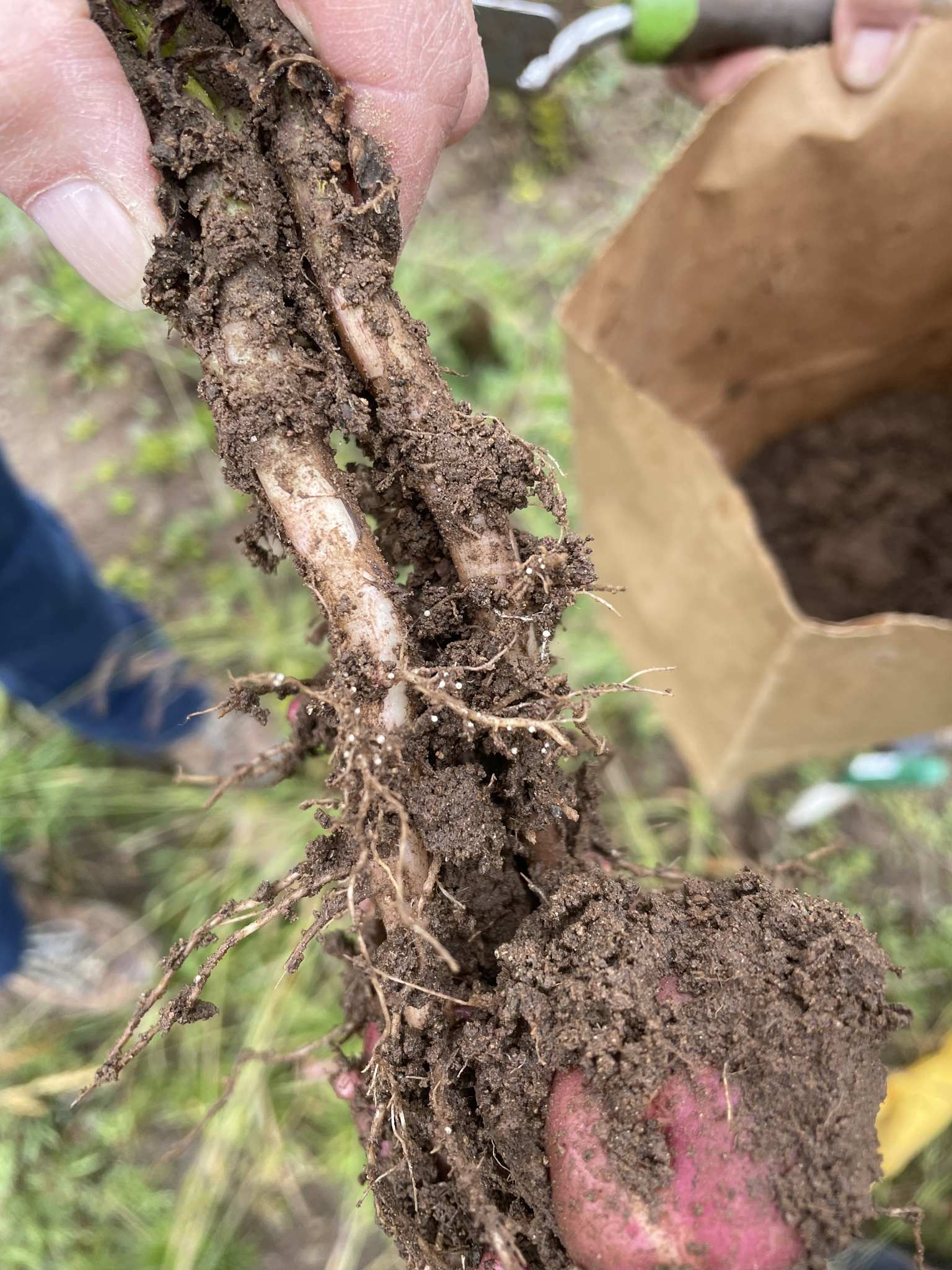
Morphological Features
Globodera pallida is a cyst-forming nematode. Cysts are subspherical, brown in color after death, with a protruding neck and a single circular fenestra; the vulval region has a subterminal anus, and the anal-vulval distance averages 75.9 µm. Second-stage juveniles (J2) are vermiform, 440–525 µm long, with a stylet 22–24 µm in length with robust forward-sloping (hooked) knobs 4–5 µm wide, and a pointed tail containing 2–8 refractive bodies in the hyaline terminus. Females are white or creamy, never yellow, with a spherical body approximately 450 µm in diameter and a projecting neck. Males are thread-like, approximately 1200 µm long.
Skantar, A. M., Handoo, Z. A., Zasada, I. A., Ingham, R. E., Carta, L. K., & Chitwood, D. J. (2007). Morphological and molecular identification of Globodera pallida associated with potato in Idaho. Journal of Nematology, 39(2), 133-144.
Host Plants (2 host plants)
Data sources: EPPO Global Database and relevant literature.
| Scientific Name | Status |
|---|---|
| Solanum melongena | Host |
| Solanum tuberosum | Host |
Quarantine Status (87 records)
Data sources: IPPC website and national quarantine websites; verified by human review.
| Country | Status | Year Added |
|---|---|---|
| Argentina | Absent | 2019 |
| Armenia | Absent | — |
| Australia | Quarantine pests | — |
| Austria | Present | 2019 |
| Azerbaijan | Absent | 2024 |
| Belgium | Present | 2019 |
| Burkina Faso | Absent | — |
| Bulgaria | Present | 2019 |
| Bahrain | Quarantine pests | 2003 |
| Belarus | Absent | 1994 |
Distribution (65 countries)
Data Sources: EPPO Global Database and GBIF.
| Country | Status | State |
|---|---|---|
| Algeria | Present | — |
| Argentina | Absent | — |
| Austria | Present | — |
| Belgium | Present | — |
| Bulgaria | Present | — |
| Bosnia and Herzegovina | Present | — |
| Belarus | Absent | — |
| Bolivia (Plurinational State of) | Present | — |
| Canada | Present | |
| Switzerland | Present | — |
Distribution Map (Latitude and longitude coordinates sourced from GBIF.)
Download CSVGenomes (1 records)
Data source: NCBI.
| Assembly Accession | Assembly Level | Genome Size(Mb) | Contig N50(Kb) | Scaffold N50(Kb) | BUSCO% | Downloads | Actions |
|---|---|---|---|---|---|---|---|
| GCA_000724045.1 | Scaffold | 123 | 11 | 120 | - |
|
|
|
GPAL001 |
|||||||
Transcriptomes (3 records)
Data source: NCBI.
| Run ID | Tissue | Developmental Stage | Sex | Read Count | Location | Actions |
|---|---|---|---|---|---|---|
| ERR13250080 | - | J2 | - | 53618574 | - | |
|
PRJEB76451 ERX12620703 ERP160979 general Illumina NovaSeq 6000 paired end sequencing Hatched J2 from 300cysts {'isolate': 'Hatched J2 from 300cysts', 'dev_stage': 'J2', 'sample name': 'SMI3B', 'insdc status': 'public', 'submitter id': 'SMI3B', 'collector name': 'Magali ESQUIBET', 'collection date': '2021-11', 'scientific_name': 'Globodera pallida', 'ena first public': '2024-06-14', 'insdc center name': 'INRA (INRA Rennes)', 'collecting institution': 'INRAE', 'geographic location (country and/or sea)': 'France'} |
||||||
| ERR13250076 | - | J2 | - | 46859600 | - | |
|
PRJEB76451 ERX12620699 ERP160979 general Illumina NovaSeq 6000 paired end sequencing Hatched J2 from 300cysts {'isolate': 'Hatched J2 from 300cysts', 'dev_stage': 'J2', 'sample name': 'SMD2B', 'insdc status': 'public', 'submitter id': 'SMD2B', 'collector name': 'Magali ESQUIBET', 'collection date': '2021-11', 'scientific_name': 'Globodera pallida', 'ena first public': '2024-06-14', 'insdc center name': 'INRA (INRA Rennes)', 'collecting institution': 'INRAE', 'geographic location (country and/or sea)': 'France'} |
||||||
| ERR15277786 | - | - | - | - | - | |
|
PRJEB91928 ERX14683482 ERP174858 general DNBSEQ-G400 paired end sequencing {'sample name': 'RNAseqAnno', 'insdc status': 'public', 'submitter id': 'RNAseqAnno', 'collection date': '2022', 'scientific_name': 'Globodera pallida', 'ena first public': '2025-07-10', 'insdc center name': 'WUR', 'geographic location (country and/or sea)': 'Netherlands'} |
||||||
DNA Barcodes (78 records)
View allData source: BOLD.
| Process ID | BIN | Marker | Length | Country | Date | Lat/Lon | Sequence |
|---|---|---|---|---|---|---|---|
| GBNEM7791-23 | - | 18S-5P | 737 | India | 2013-11-03 | 11.45, 76.73 | |
| GBNEM7790-23 | - | 18S-5P | 742 | India | 2013-11-03 | 11.54, 76.72 | |
| GBNEM7789-23 | - | 18S-5P | 742 | India | 2013-11-03 | 11.39, 76.69 | |
| GBNEM7788-23 | - | 18S-5P | 738 | India | 2013-11-03 | 11.41, 76.71 | |
| GBNEM7787-23 | - | 18S-5P | 741 | India | 2013-11-03 | 11.33, 76.64 | |
| GBNEM7786-23 | - | 18S-5P | 716 | Algeria | - | - | |
| GBNEM7785-23 | - | 18S-5P | 742 | India | 2013-11-03 | 11.45, 76.73 | |
| GBNEM7784-23 | - | 18S-5P | 726 | India | 2013-11-03 | 11.36, 76.64 | |
| GBNEM7783-23 | - | 18S-5P | 743 | India | 2013-11-03 | 11.4, 76.73 | |
| GBNEM7782-23 | - | 18S-5P | 741 | India | 2013-11-03 | 11.33, 76.67 |
Literature
Fetching literature from NCBI PubMed...
Failed to fetch literature