Spodoptera frugiperda
TaxID: 7108
Basic Information
Spodoptera frugiperda
Fall Armyworm, fall armyworm
The fall armyworm (Spodoptera frugiperda) is a species in the order Lepidoptera and one of the species of the fall armyworm moths distinguished by their larval life stage. The term "armyworm" can refer to several species, often describing the large-scale invasive behavior of the species' larval stage. It is regarded as a pest and can damage and destroy a wide variety of crops, which causes large economic damage. Its scientific name derives from frugiperda, which is Latin for lost fruit, named because of the species' ability to destroy crops. Because of its propensity for destruction, the fall armyworm's habits and possibilities for crop protection have been studied in depth. It is also a notable case for studying sympatric speciation, as it appears to be diverging into two species currently. Another remarkable trait of the larva is that they consistently practice cannibalism, despite its fitness costs. The fall armyworm is active at a different time of year from the true armyworm, another species in the order Lepidoptera and family Noctuidae, but of the genus Mythimna. Outbreaks of the true armyworm usually occur during the early part of the summer; the fall armyworm does most damage in the late summer in the southern part of the United States, and early fall in the northern regions.
from Wikipedia
Taxonomic Information
Eukaryota
Arthropoda
Insecta
Lepidoptera
Noctuidae
Spodoptera
frugiperda
nan
Species
nan
k__Eukaryota;p__Arthropoda;c__Insecta;o__Lepidoptera;f__Noctuidae;g__Spodoptera;s__Spodoptera frugiperda
nan
Arthropods
Photos (5 photos)
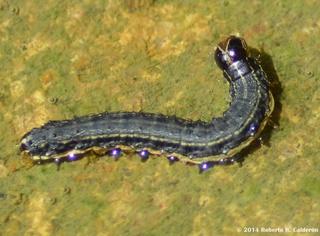

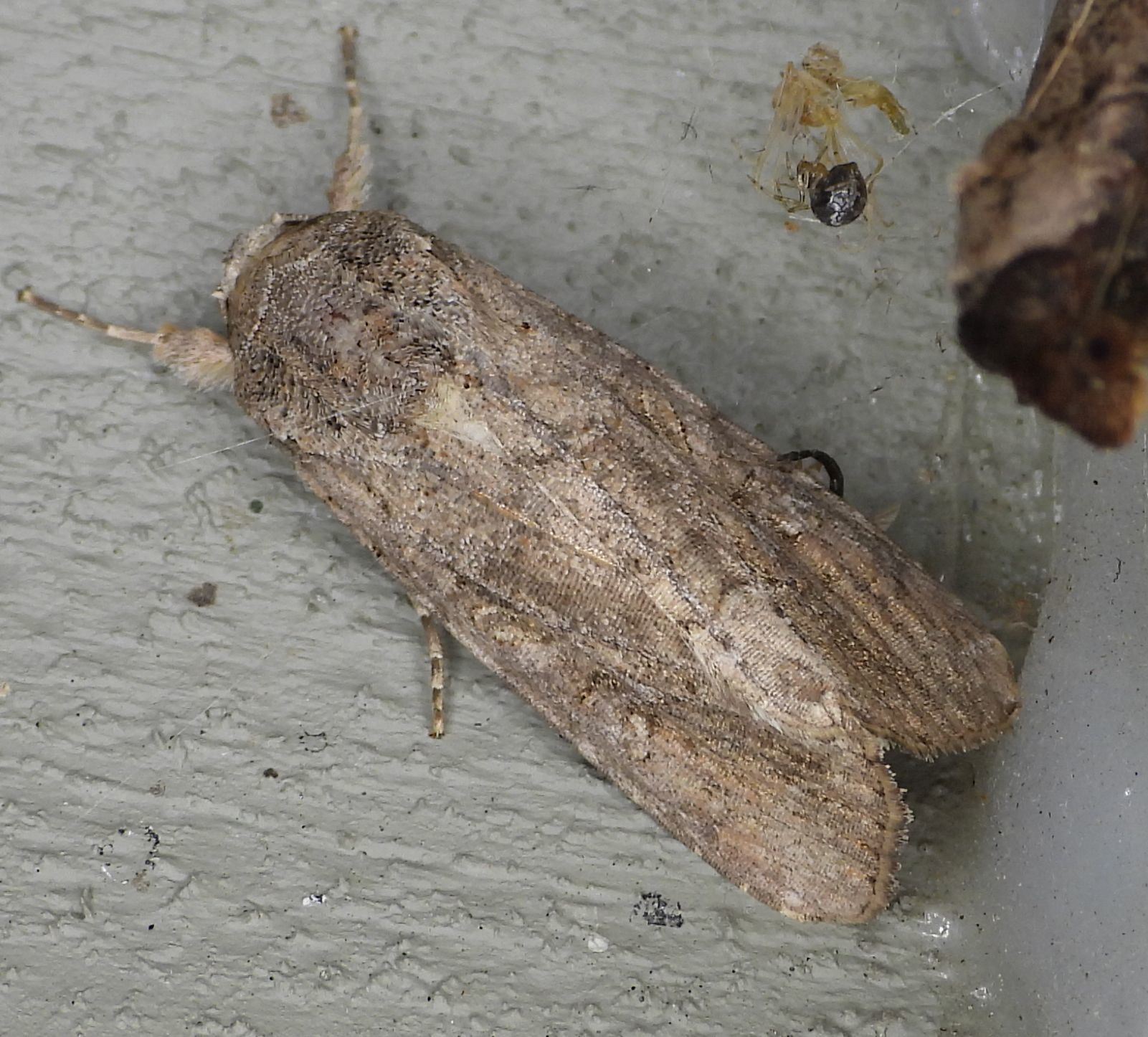
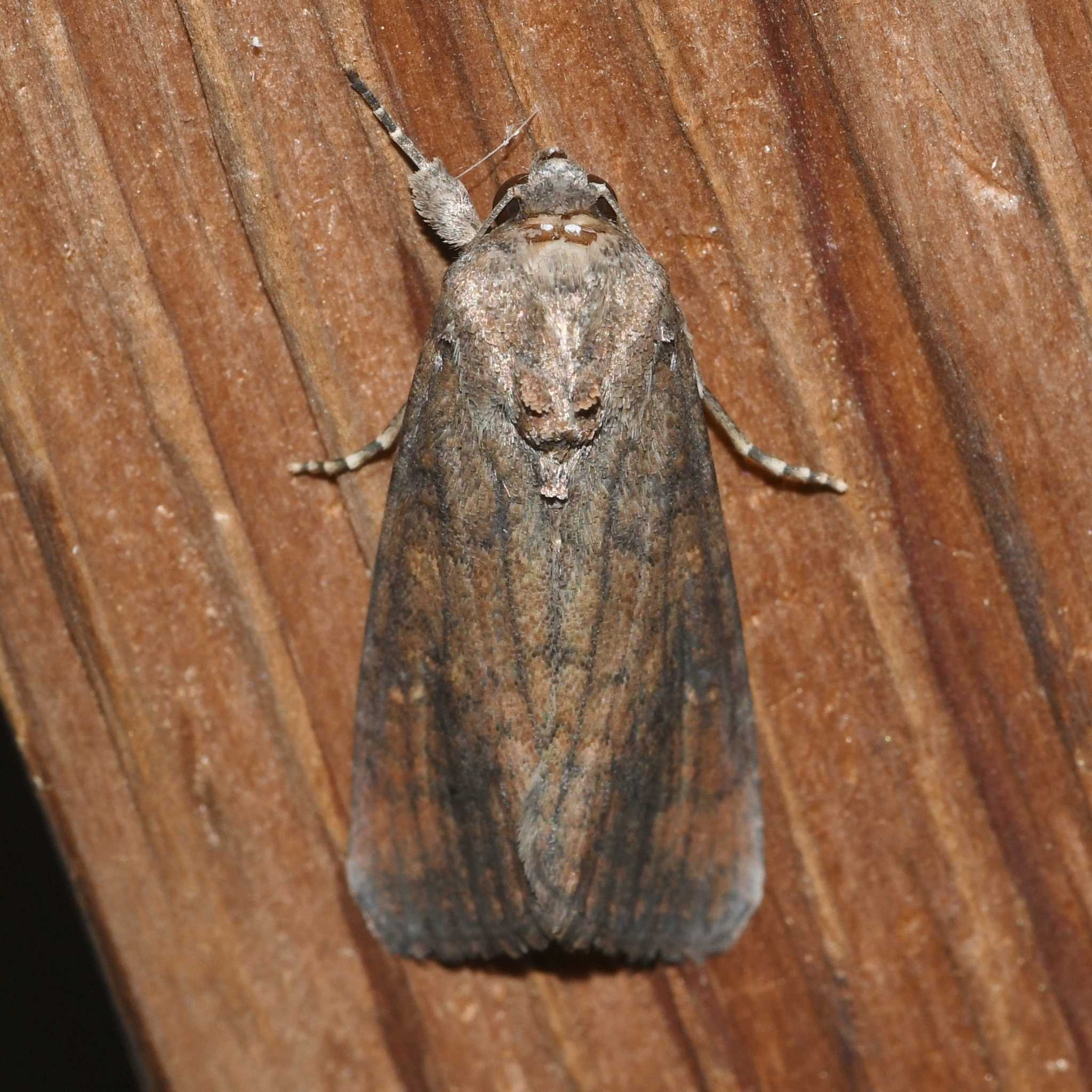
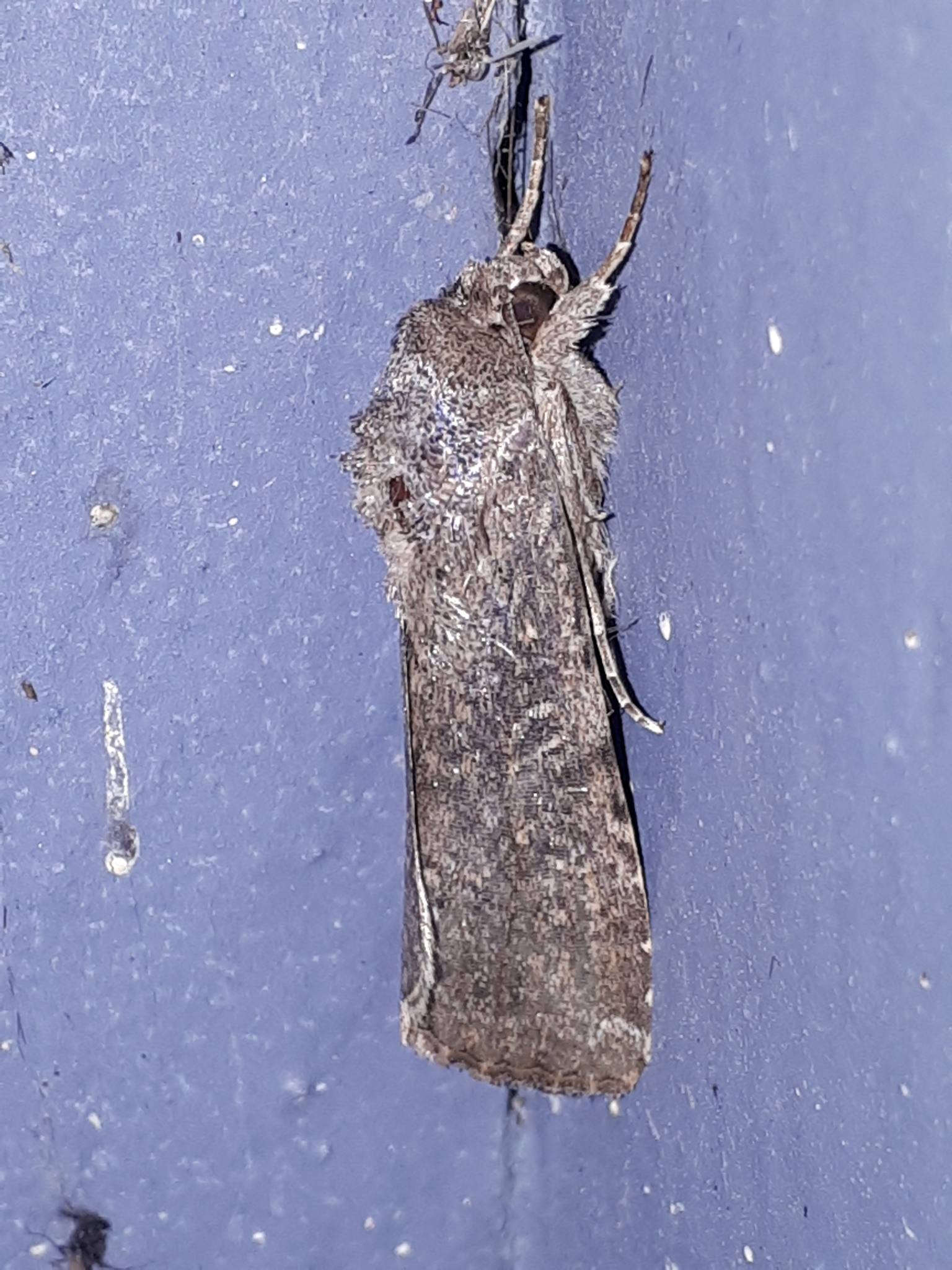
Morphological Features
Adult male body length 1.3 cm, forewing length 1.4 cm, hind wing length 1.0 cm, wing span about 3.2 cm. Adult female robust, body length 1.4 cm, forewing length 1.6 cm, hind wing length 1.2 cm, wing span 3.3 cm. Male forewings darker than female. Forewing with a brown reniform spot and a white-margined light brown area at tips resembling the letter 'A'; orbicular spot light brown, oval and oblique with strongly contrasting crosswise lines and a row of small black hour-glass shaped markings near the apical margin. Hind wings opalescent, semi-hyaline white with a dark brown patch on the margin. Larva: first instar very tiny with large black head and light greenish body covered with minute black hairs; second instar about 12–15 mm; fourth instar body color varies from olive brown to dark brownish with red pigmentation; fifth instar grayish brown to cream dorsally, greenish ventrally and sub-ventrally. Mature larva has an inverted 'Y'-shaped white marking on the head and distinct dark spots on the body.
Desavath Gouthami. 2025. Taxonomic Description for Identification of Spodoptera frugiperda (J.E. Smith) and Spodoptera litura (Fabricius). Indian Journal of Ecology
Host Plants (290 host plants)
Data sources: EPPO Global Database and relevant literature.
| Scientific Name | Status |
|---|---|
| Abelmoschus esculentus | Host |
| Acacia mearnsii | Host |
| Acalypha sp. | Host |
| Acanthospermum hispidum | Host |
| Ageratum conyzoides | Host |
| Agrostis gigantea | Host |
| Agrostis hyemalis | Host |
| Agrostis stolonifera | Host |
| Allium cepa | Host |
| Allium fistulosum | Host |
Quarantine Status (63 records)
Data sources: IPPC website and national quarantine websites; verified by human review.
| Country | Status | Year Added |
|---|---|---|
| Albania | Quarantine pests | — |
| Armenia | Absent | — |
| Austria | Quarantine pests | 2019 |
| Belgium | Unknow | 2019 |
| Bulgaria | Quarantine pests | 2019 |
| Bahrain | Quarantine pests | 2003 |
| Belarus | Absent | — |
| Switzerland | A1 list | 2019 |
| Cyprus | Quarantine pests | 2019 |
| Czechia | Quarantine pests | 2019 |
Distribution (146 countries)
Data Sources: EPPO Global Database and GBIF.
| Country | Status | State |
|---|---|---|
| Antigua and Barbuda | Present | — |
| Angola | Present | — |
| Anguilla | Present | — |
| United Arab Emirates | Present | — |
| Argentina | Present | — |
| Australia | Present | |
| Burundi | Present | — |
| Benin | Present | — |
| Burkina Faso | Present | — |
| Bangladesh | Present | — |
Distribution Map (Latitude and longitude coordinates sourced from GBIF.)
Download CSVGenomes (11 records)
Data source: NCBI.
| Assembly Accession | Assembly Level | Genome Size(Mb) | Contig N50(Kb) | Scaffold N50(Kb) | BUSCO% | Downloads | Actions |
|---|---|---|---|---|---|---|---|
| GCF_023101765.2 | Chromosome | - | - | - | - | - |
|
|
AGI-APGP_CSIRO_Sfru_2.0 |
|||||||
| GCF_011064685.2 | Chromosome | - | - | - | - | - |
|
|
ZJU_Sfru_1.1 |
|||||||
| GCA_976974275.1 | Scaffold | - | - | - | - | - |
|
|
sfC.ver5 |
|||||||
| GCA_900240015.1 | Scaffold | - | - | - | - | - |
|
|
SF_CORN_1 |
|||||||
| GCA_019297735.2 | Scaffold | - | - | - | - | - |
|
|
ASM1929773v2 |
|||||||
| GCA_015832365.1 | Scaffold | - | - | - | - | - |
|
|
ASM1583236v1 |
|||||||
| GCA_012979215.2 | Chromosome | - | - | - | - | - |
|
|
ASM1297921v2 |
|||||||
| GCA_011064685.1 | Chromosome | 486 | 1130 | 16346 | - |
|
|
|
|
|||||||
| GCA_002811805.1 | Scaffold | - | - | - | - | - |
|
|
Sf-RVN WGS |
|||||||
| GCA_002213285.2 | Scaffold | - | - | - | - | - |
|
|
Sf9_draft_v2.0 |
|||||||
Transcriptomes (3 records)
Data source: NCBI.
| Run ID | Tissue | Developmental Stage | Sex | Read Count | Location | Actions |
|---|---|---|---|---|---|---|
| SRR34941135 | The entire larva | - | - | 20138800 | China: Xinxiang | |
|
PRJNA1304218 SRX30063639 SRP607948 insect RNA-Seq of Spodoptera frugiperda: larval LC50 mg/kg ribavirin treated with ribavirin {'host': 'Maize', 'tissue': 'The entire larva', 'isolate': 'treated with ribavirin', 'replicate': 'replicate=biological replicate4', 'geo_loc_name': 'China: Xinxiang', 'biosamplemodel': 'Invertebrate', 'collection_date': '2022-09-09'} |
||||||
| SRR34941134 | The entire larva | - | - | 21506294 | China: Xinxiang | |
|
PRJNA1304218 SRX30063640 SRP607948 insect RNA-Seq of Spodoptera frugiperda: larval LC50 mg/kg ribavirin treated with ribavirin {'host': 'Maize', 'tissue': 'The entire larva', 'isolate': 'treated with ribavirin', 'replicate': 'replicate=biological replicate5', 'geo_loc_name': 'China: Xinxiang', 'biosamplemodel': 'Invertebrate', 'collection_date': '2022-09-09'} |
||||||
| SRR34941133 | The entire larva | - | - | 19986488 | China: Xinxiang | |
|
PRJNA1304218 SRX30063641 SRP607948 insect RNA-Seq of Spodoptera frugiperda: larval LC50 mg/kg ribavirin treated with ribavirin {'host': 'Maize', 'tissue': 'The entire larva', 'isolate': 'treated with ribavirin', 'replicate': 'replicate=biological replicate6', 'geo_loc_name': 'China: Xinxiang', 'biosamplemodel': 'Invertebrate', 'collection_date': '2022-09-09'} |
||||||
DNA Barcodes (3985 records)
View allData source: BOLD.
| Process ID | BIN | Marker | Length | Country | Date | Lat/Lon | Sequence |
|---|---|---|---|---|---|---|---|
| XAH550-05 | BOLD:AAA4532 | COI-5P | 658 | Canada | 2005-09-23 | 43.537, -80.134 | |
| XAH548-05 | BOLD:AAA4532 | COI-5P | 658 | Canada | 2005-09-23 | 43.537, -80.134 | |
| XAD509-04 | BOLD:AAA4532 | COI-5P | 617 | Canada | 2002-10-01 | 43.537, -80.134 | |
| XAD490-04 | BOLD:AAA4532 | COI-5P | 557 | Canada | 2002-10-01 | 43.537, -80.134 | |
| XAD265-04 | BOLD:AAA4532 | COI-5P | 594 | Canada | 2002-09-01 | 43.537, -80.134 | |
| XAD239-04 | BOLD:AAA4532 | COI-5P | 658 | Canada | 2002-08-21 | 43.537, -80.134 | |
| XAD236-04 | BOLD:AAA4532 | COI-5P | 658 | Canada | 2002-08-21 | 43.537, -80.134 | |
| USLEP1223-10 | BOLD:AAA4532 | COI-5P | 658 | United States | 2010-04-23 | 32.64953, -111.42951 | |
| TZBCA211-06 | BOLD:AAA4532 | COI-5P | 658 | Canada | 2006-08-08 | - | |
| TZBCA210-06 | BOLD:AAA4532 | COI-5P | 658 | Canada | 2006-08-09 | - |
Literature
Fetching literature from NCBI PubMed...
Failed to fetch literature