Xyleborinus saxesenii
TaxID: 1230758
Basic Information
Xyleborinus saxesenii
Lesser Shothole Borer
Xyleborinus saxesenii, commonly known as the fruit-tree pinhole borer, is a species of ambrosia beetle in the family Curculionidae. It is native to the Palaearctic region but has been introduced in many locations, including North America. X. saxesenii typically live in freshly dead wood, but it has also been reported to attack live trees. Such attacks on live trees may lead to economic damage. Like other ambrosia beetles, Xyleborinus saxesenii has a symbiotic relationship with ambrosia fungi, particularly the Raffaelea sulfurea species. X. saxesenii inoculate the wood in which they inhabit with the fungus and farm it to utilize it as a food resource. Although there are benefits to farming fungi, there are also costs in the form of microbes and pathogens that infiltrate these fungal farms. Xyleborinus saxesenii are a haplodiploid species that have a heavily biased sex ratio in favor of females. Males do not contribute much to the productivity of the nests, and typically spend a large amount of their time searching for mates. Unlike males, females contribute to gallery productivity and may even delay sexual dispersal to help with tasks such as brood care. Both adult females and larvae contribute to tasks within the gallery, but there is often an age-based division of labor in these tasks.
from Wikipedia
Taxonomic Information
Metazoa
Arthropoda
Insecta
Coleoptera
Curculionidae
Xyleborinus
saxesenii
unclassified
Species
nan
k__Metazoa;p__Arthropoda;c__Insecta;o__Coleoptera;f__Curculionidae;g__Xyleborinus;s__Xyleborinus saxesenii
nan
Arthropods
Photos (5 photos)
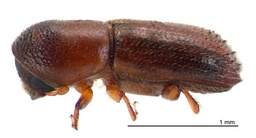
Morphological Features
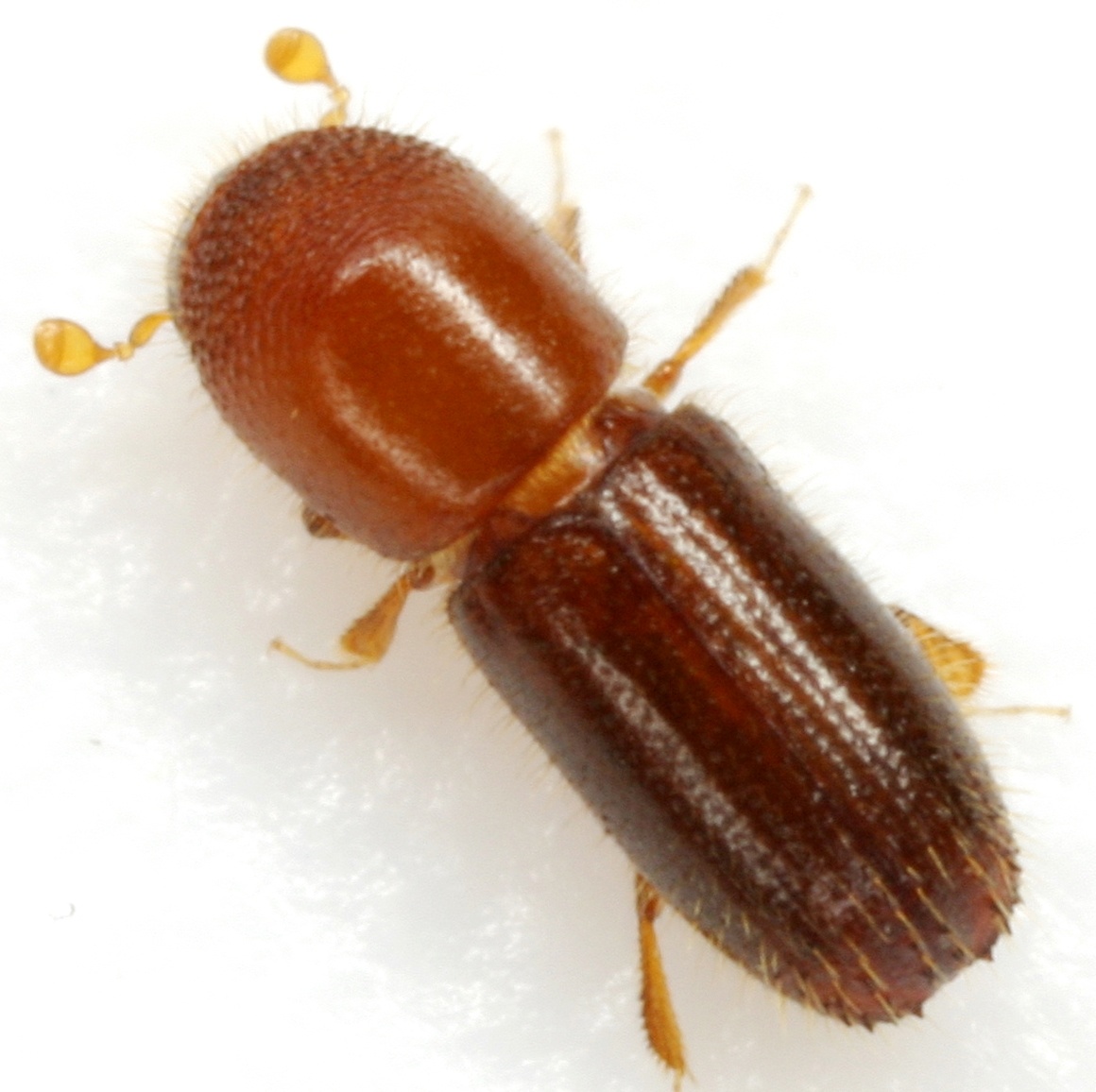
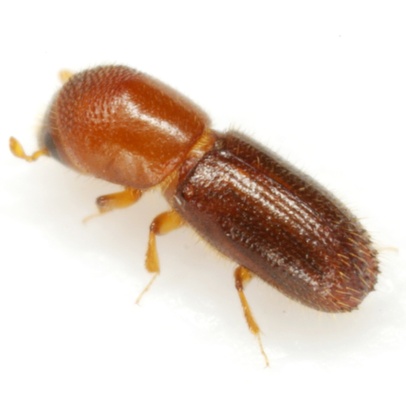
Female: body length 1.9–3.9 mm. Frons broadly convex, surface shining, reticulate with rather coarse, shallow punctures. Pronotum 1.1× as long as wide, summit slightly in front of middle of pronotum length; anterior slope coarsely, closely asperate; sides almost straight and parallel on more than basal half, broadly rounded in front; anterior margin unarmed. Elytra 1.58× as long as wide, 1.26× as long as pronotum; interstriae more than twice as wide as striae, smooth, shining with rather minute punctures, some near declivity replaced by small tubercles. Vestiture of short, fine strial hair, and long, erect, rather coarse interstrial setae, some setae on declivity more than twice as long as distance between rows. Antennal club obliquely truncate with segment 1 nearly covering entire posterior face.
Plazi taxonomic treatment
Host Plants (0 host plants)
Data sources: EPPO Global Database and relevant literature.
No host plants available.
Quarantine Status (4 records)
Data sources: IPPC website and national quarantine websites; verified by human review.
Distribution (34 countries)
Data Sources: EPPO Global Database and GBIF.
| Country | Status | State |
|---|---|---|
| Argentina | Present | — |
| Armenia | Present | — |
| Australia | Present | — |
| Austria | Present | — |
| Azerbaijan | Present | — |
| Belgium | Present | — |
| Bulgaria | Present | — |
| Canada | Present | — |
| Switzerland | Present | — |
| China | Present | — |
Distribution Map (Latitude and longitude coordinates sourced from GBIF.)
Download CSVGenomes (0 records)
Data source: NCBI.
No genome records available.
Transcriptomes (0 records)
Data source: NCBI.
No transcriptome records available.
Literature
Fetching literature from NCBI PubMed...
Failed to fetch literature